

Engineering · 5 min read
Day 0 support & SOTA inference for Recursive Intelligence Flint
Flint on RTX 5090 and Apple Silicon: 680 tokens/s at 1K on RTX 5090, plus faster prefill and decode than the official rec engine on M4 Pro.
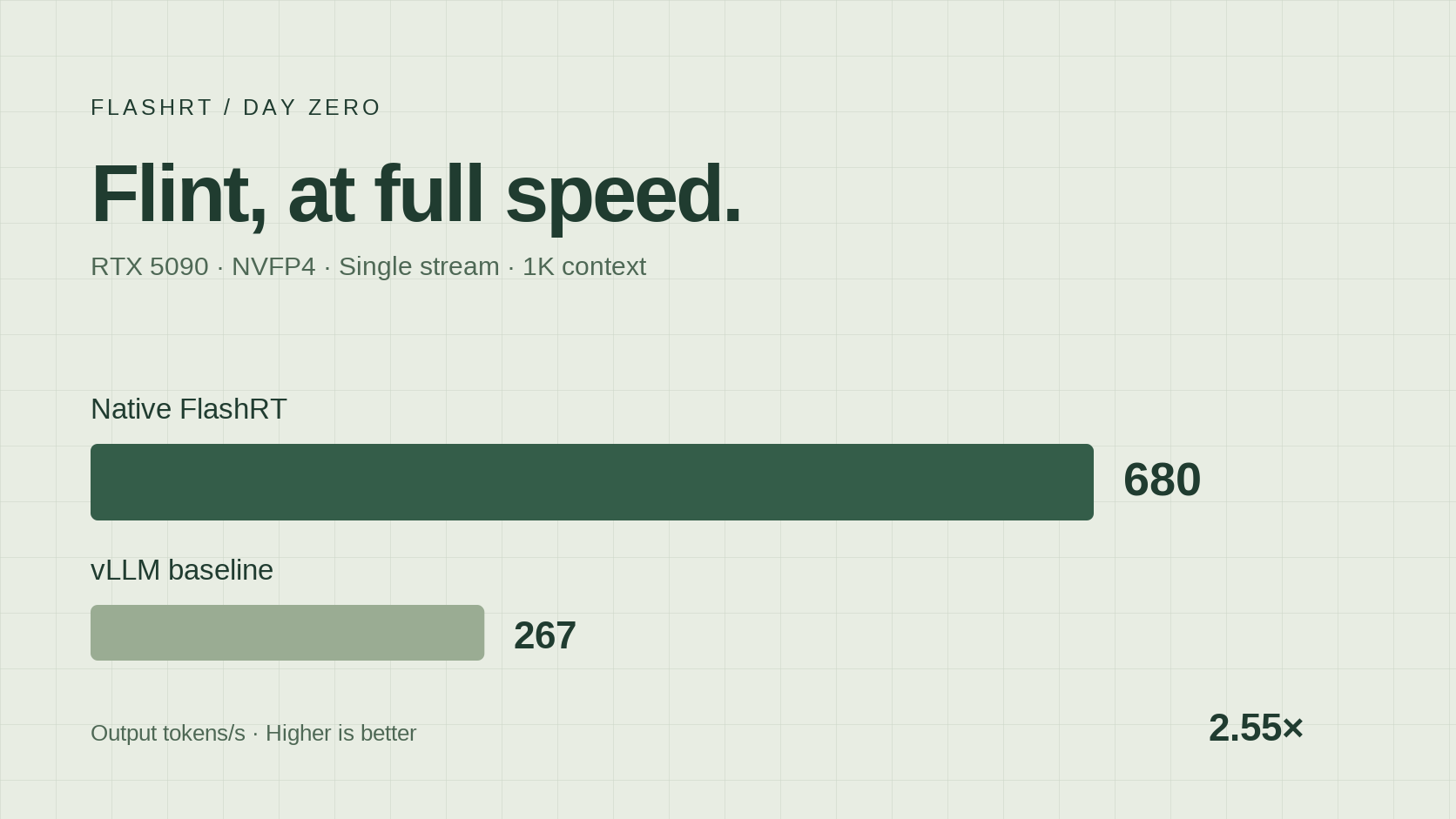
On the day Recursive released Flint, we completed native FlashRT support on RTX 5090. With Flint NVFP4, native FlashRT reaches 680 output tokens/s at 1K context in single-stream serving, a 2.55× throughput improvement over the paired vLLM baseline.
FlashRT also integrates with llama.cpp and vLLM, bringing acceleration into existing serving stacks. Together, the native engine and runtime integrations extend our work on end-to-end inference optimization for latency-sensitive agents.
Single-stream serving: 680 tokens/s at 1K context
The first benchmark compares single-stream serving throughput at batch size 1 on RTX 5090 using Flint NVFP4. Results are output tokens per second; higher is better.
| Implementation | 1K context | 100K context |
|---|---|---|
| Original llama.cpp | 221 | 157 |
| FlashRT-optimized llama.cpp | 467 | 249 |
| vLLM | 267 | 180 |
| Native FlashRT | 680 | 303 |
At 1K context, native FlashRT delivers 2.55× the throughput of vLLM (680 versus 267 tokens/s). At 100K context, it delivers 1.68× (303 versus 180 tokens/s). The FlashRT-optimized llama.cpp configuration also improves throughput at both context lengths: from 221 to 467 tokens/s at 1K, and from 157 to 249 tokens/s at 100K.
Acceleration inside llama.cpp and vLLM
A separate integration benchmark measures engine-level batched decode throughput: aggregate output tokens per second across all sequences. Each FlashRT result is compared with its paired baseline within the same integration and batch size.
| Integration | Batch | Baseline | With FlashRT | Speedup |
|---|---|---|---|---|
| llama.cpp | 1 | 226 | 514 | 2.27× |
| llama.cpp | 8 | 963 | 1,191 | 1.24× |
| vLLM | 1 | 268 | 545 | 2.03× |
| vLLM | 8 | 1,417 | 1,715 | 1.21× |
Table 1 reports serving throughput; Table 2 reports engine-level decode throughput. These are separate benchmark campaigns with different workloads, so their absolute throughput values should not be compared directly. Each speedup uses its paired baseline. Larger-batch optimization and evaluation are ongoing.
The integration results show gains in both runtimes at batch sizes 1 and 8. The largest relative gains in this campaign occur at batch size 1: 2.27× in llama.cpp and 2.03× in vLLM. This is especially relevant to our focus on low-latency agent inference.
Apple Silicon: faster than Flint’s official engine
Building on Flint’s official rec v0.1.1 (MLX) engine, we optimized prefill and decode with native Metal execution in FlashRT. On a Mac mini M4 Pro (20-core GPU, 64 GB), FlashRT uses the same Flint int4 checkpoint and token inputs, with no additional quantization.
- Faster prefill: 8K prompts fall from 11.94–12.27 s to 8.18 s (1.46–1.50×). At 128K, latency falls from 603.1 s to 473.1 s (1.27×).
- Faster decode: at 64K context, greedy throughput rises from 50.1 to 63.5 tokens/s (+27%); default sampling rises from 49.3 to 64.0 tokens/s (+30%). At 128K, the gains reach +41% and +42%, respectively.
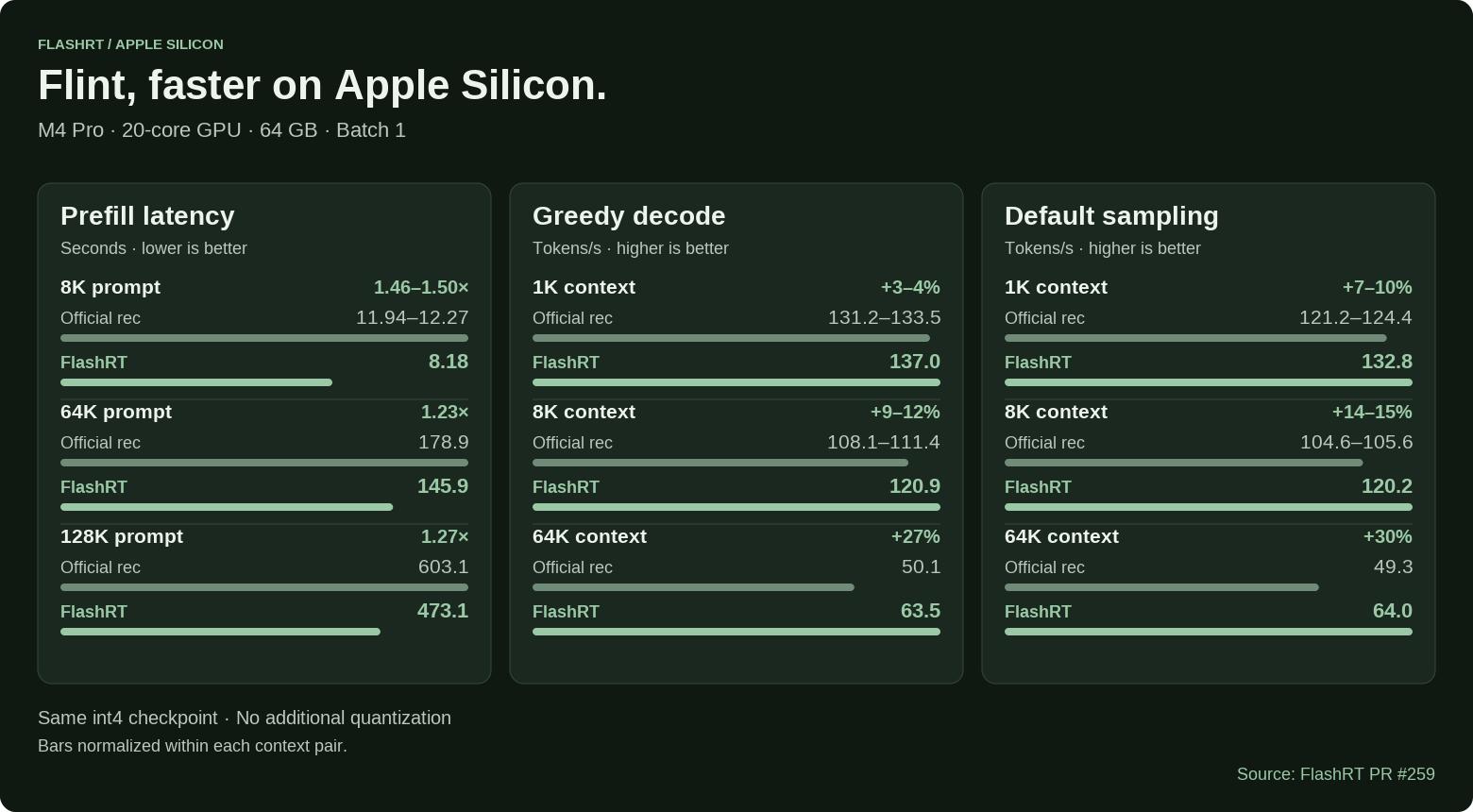
These Apple results are separate from the RTX 5090 benchmarks above. Short-context baseline ranges bracket thermal drift; 64K and 128K results use one run per engine. Implementation, validation, and reproduction details: FlashRT PR #259.
From model release to optimized execution
A capable model needs a high-performance inference engine to turn its capabilities into a responsive experience. Our focus is end-to-end optimization of the inference stack, including native execution and integration with the runtimes developers already use.
This day-zero adaptation was driven by our in-house harness and cognitive recursive self-improvement (RSI) approach. The Flint results are another application of the deployment optimization work described in AnyDev-auto.
What comes next
We are continuing larger-batch optimization and evaluation, and plan to extend this work to post-training acceleration. Our goal is to reduce the time and compute cost required to put capable models to work.
Explore and star FlashRT on GitHub. If you want to help connect the digital and physical worlds through high-performance AI systems, join the team.