

Engineering · 6 min read
Anydev-Auto: A Self-Improving Agent System, from Human-in-the-Loop to Fully Automatic
Anydev-Auto takes LingBot-VA to 10.1× on Jetson AGX Thor, and the loop that improves the system is moving from human-in-the-loop to fully automatic.
10.1× on LingBot-VA, 5.29× on FLUX 3 Action — No Model Retraining Required
The biggest bottleneck scaling physical AI today is not model intelligence — it is deployment engineering. Vision-language-action (VLA), video-action and world-action models iterate every few weeks, but manually tuning inference pipelines for each new model and hardware target takes 3–6 months of specialist engineering per update. Anydev-Auto compresses that cycle into days — without modifying model weights, retraining or replacing existing customer stacks.
Built on our open-source FlashRT inference engine, Anydev-Auto combines a coding agent, a Verified Harness and recursive self-improvement (RSI) to automatically search, validate, improve and reuse deployment optimizations. Our delivered pipelines run 10.1× faster for LingBot-VA on Jetson AGX Thor and 5.29× faster for FLUX 3 Action on RTX 5090 than their official BF16 baselines. Given FlashRT as context, the agent alone reaches 3.37× on LingBot-VA; adding the Verified Harness and RSI makes the exact same agent another 3.00× faster.

How Anydev-Auto works
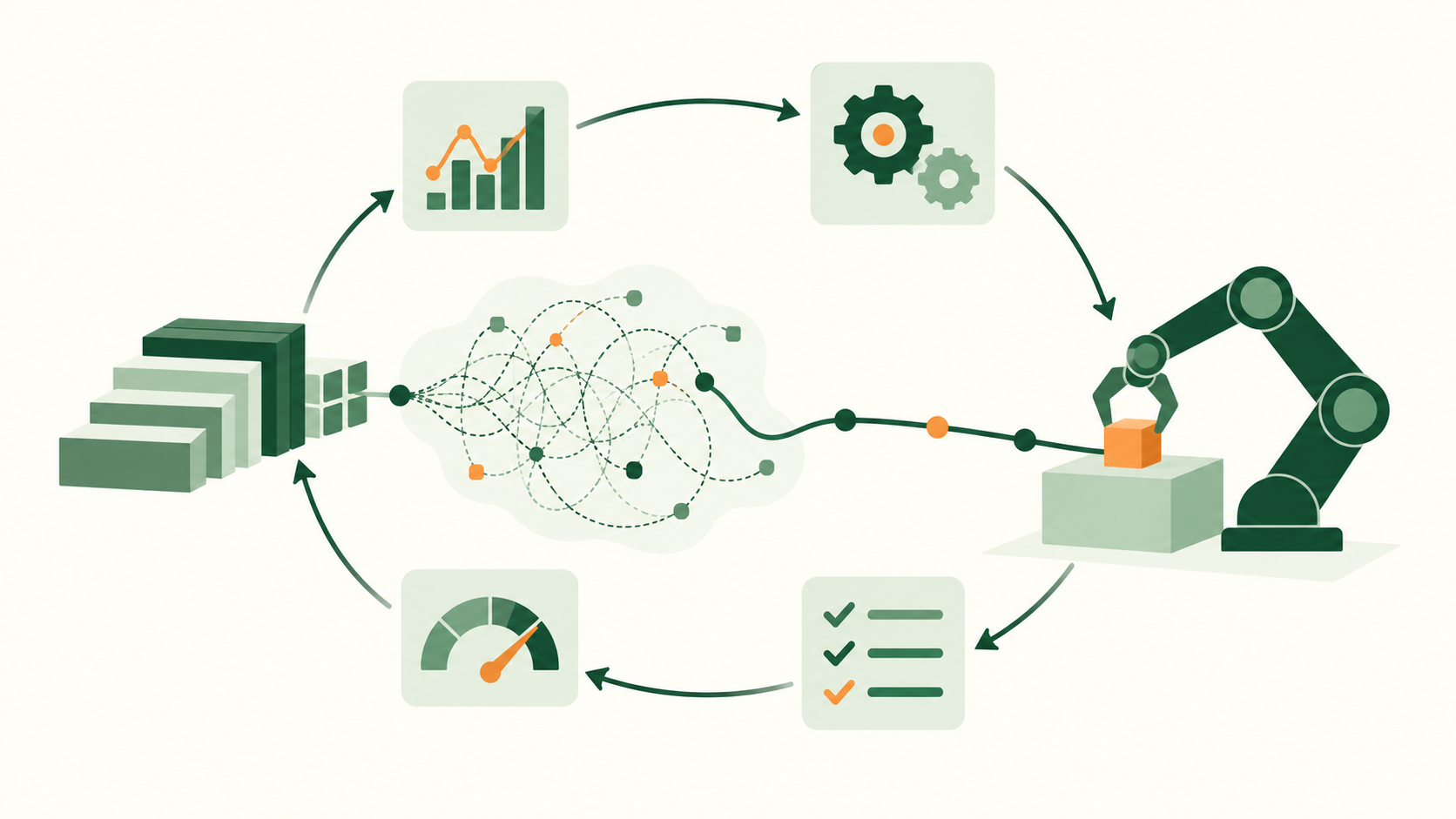
Coding agents can write fast isolated kernels, but they routinely stall on end-to-end physical AI pipelines — abandoning promising ideas after minor setup errors, repeating failed experiments across long sessions or stopping prematurely. Anydev-Auto solves this by pairing the coding agent with a stateful Verified Harness across two coupled loops:
- Execution loop (Auto-Search & Validate): Within an optimization run, the agent implements and profiles runtime changes on FlashRT while the Verified Harness tracks experimental state — what was tested, under which conditions, what was rejected and what checks remain open. Fixed acceptance gates ensure a speedup is kept only if it meets strict output-quality thresholds on the full model.
- Self-improvement loop (Improve & Reuse): Between runs, a cognitive RSI agent audits completed trajectories, diagnoses where guidance fell short and upgrades the harness rules and search tools. Every revision is unit-tested offline on historical run states before adoption, so each run makes the platform faster and cheaper for the next deployment.
Throughout both loops, all model weights stay fixed — neither the deployed physical AI model nor the agents are retrained. What evolves is the deployment intelligence in the harness.

What each part adds
We measured the additive contribution of each component on LingBot-VA targeting NVIDIA Jetson AGX Thor, with FlashRT available in every condition and all model weights held fixed:
| Configuration | Latency | Speedup over BF16 |
|---|---|---|
| Official BF16 baseline | 9,309.5 ms | 1.00× |
| Agent alone (FlashRT context) | 2,762.7 ms | 3.37× |
| Agent + Verified Harness | 1,915.5 ms | 4.86× |
| Anydev-Auto (Agent + Verified Harness + RSI) | 920.9 ms | 10.1× |
While the unguided agent plateaus at 3.37×, adding the Verified Harness reaches 4.86× and RSI-evolved guidance pushes the exact same agent to 10.1× (920.9 ms). In controlled comparisons from an identical starting snapshot, the RSI-evolved Verifier delivers a 2.27× speedup over an unguided agent and 1.97× over an early Verifier by turning three recurring failure modes into permanent rules:
- Reopening prematurely abandoned optimizations: When the agent hit setup friction on new low-precision attention and matrix kernels, it tried to exit four times. Because the Verifier distinguishes a setup error from a measured slowdown, it blocked premature exit until the kernels were properly integrated and tested in the full model.
- Retaining counter-intuitive negative results: Fusing quantization kernels eliminated 4,320 kernel launches per cycle, which looked promising in isolation, but made the full model 257 ms slower due to memory-bandwidth contention. The Verifier locked in that negative result so later runs never wasted GPU hours repeating it.
- Enforcing complete candidate coverage: The Verifier tracks every candidate optimization per operator independently, ensuring one early speedup never masks remaining gains on the same layer.
Case 1: LingBot-VA on Jetson AGX Thor — 10.1× Edge Speedup
Edge robotics deployments live or die by closed-loop latency under tight onboard compute budgets. On Jetson AGX Thor, Anydev-Auto accelerates LingBot-VA from 9,309.5 ms to 920.9 ms (10.1× faster) in a single automated optimization run, preserving action accuracy with original model weights.
| Configuration | Model-cycle latency | Speedup | Output fidelity |
|---|---|---|---|
| Official BF16 baseline | 9,309.5 ms | 1.00× | Reference |
| Anydev-Auto | 920.9 ms | 10.1× | 0.99787 action cosine |
For robot OEMs, this turns months of manual edge optimization into an automated run costing roughly $110–$125 in API fees — unlocking real-time control frequencies on existing bill-of-materials hardware without sending data off-device.
Case 2: FLUX 3 Action on RTX 5090 — 5.29× Faster With Comparable Task Success
On a single RTX 5090, Anydev-Auto delivers a 5.29× speedup over the official BF16 baseline for Black Forest Labs's FLUX 3 Action and runs 2.53× faster than the official FP8 path — with no distillation, no retraining and no loss in task success.
| Configuration | Latency / 32-action chunk | Speedup over BF16 | RoboLab-120 Success |
|---|---|---|---|
| Official BF16 baseline | 1,458.62 ms | 1.00× | 41.60 ± 0.46% |
| Official FP8 | 697.00 ms | 2.09× | — |
| Anydev-Auto | 275.51 ms | 5.29× | 42.08% |
Instead of settling for one-size-fits-all compiler defaults, Anydev-Auto tailors precision scheduling and kernel fusion to the exact model and GPU, retaining full 4-step classifier-free guidance and matching baseline task success on RoboLab-120.
From human-in-the-loop to fully automatic
While each optimization run executes autonomously, the self-improvement loop between runs is advancing to full automation in three stages:
- Stage 1 — Human-in-the-loop: Engineers reviewed completed run records and authored early Verifier upgrades that established the 10.1× LingBot-VA and 5.29× FLUX results.
- Stage 2 — Cognitive RSI agent with human approval (current): The cognitive RSI agent autonomously reconstructs run trajectories, diagnoses guidance gaps, writes the Verifier revision and validates it via offline paired replay. A human reviews and approves the tested change before promotion.
- Stage 3 — Fully automatic: Revisions that pass paired replay and safety checks are promoted automatically, backed by sampled audits and instant rollback.
Because RSI evolves the harness rather than model weights, candidate revisions can be validated deterministically in seconds at zero GPU cost. In offline paired replay across production snapshots, the cognitive agent's synthesized rule accurately blocks premature exits across operator families while preserving 100% of prior valid decisions with zero false positives.
Compounding moat and unit economics
Every deployment run makes Anydev-Auto smarter and cheaper for the next model. When reusing RSI-evolved harness rules and search tools on Deformable DETR, a second run reached a faster latency (5.34 ms vs. 5.47 ms, down from 10.87 ms) while cutting agent input tokens by 94.5% (4,125K → 226K) and context usage by 60.2%. Across our broader deployment library on NVIDIA and AMD silicon, the same workflow delivers 6.49× over PyTorch (2.45× over TensorRT) on π0.5 for Thor, 26.07× over OpenPI on π0.5 for RTX 5090, 5.32× on GR00T N1.7 for Thor and 680 tokens/s on Flint LLM (2.55× over vLLM).
For physical AI teams, this changes the economics of deployment:
- Months to days, at ~$120 per run: Replaces 3–6 months of scarce systems-engineering payroll per model update with an automated workflow.
- No retraining or stack lock-in: Operates with original model weights and outputs native deployment engines compatible with existing production workflows.
- Works with any frontier coding agent: Because the Verified Harness is decoupled from LLM weights, accumulated deployment intelligence transfers seamlessly across Claude Code, Codex, OpenCode and future frontier models.
If you are deploying a VLA, video-action or world-action model and want to see what Anydev-Auto can deliver on your models and hardware, reach out for a private evaluation.